
Yesterday I was so happy and relaxed. Lying in the bath, music playing, talking to myself the way I do when no one’s watching. And then it hit — the way memories do when your body finally feels safe enough to let them surface.
The moment he told me it was over.
Not the clean kind of over.
The kind where he confessed he loved me so much, right before telling me my experience was wrong. That he was perfect. That I was the problem. He made promises he had no intention of keeping, and when I finally spoke what I needed — clearly, honestly, legally — he answered with cruelty.
You’ll never have anything. No car. You’re just a broke bitch. Useless.
I’m picking up my 26-plate Mini soon. So — with love — fuck you.
But here’s the thing I want to actually talk about. When the memory hit, I got scared. Scared that feeling that pain again meant I hadn’t healed. That I hadn’t progressed as far as I thought.
Then I realised — the fear wasn’t proof that I was broken. It was proof that something still needed releasing.
The fear of speaking my truth and making people uncomfortable.
The fear of rejection for showing my real self.
The words he put in my body that I’d been carrying without knowing.
I may have emotionally moved on. But my body still remembered. So for the first time, I let it. I beat my chest to the music. I let the grief and the hurt and the heartbreak move through me instead of holding still so it couldn’t find me. Emotions came. Memories came. I stopped blocking them and let them flow.
I reminded my body out loud: That was then. Right now, we are safe.
Afterward, I got into bed and held the image of my mom close. I placed onyx under my pillow — to protect my sleep, my subconscious, wherever I was going to travel that night.
Beating my chest felt familiar. Like my body knew what it needed to do, without thinking. Just feeling. We’re catching up with what our ancestors been knowing. Grief lives in the chest.
Now let’s talk about our hearts for a minute. We grew up being told it’s a pump, that moves blood around your body. We were taught wrong. The HeartMath Institute did extensive research on this.
The heart is a vortex.
Let that sit with you for a minute because it gets better. The heart generates the largest electromagnetic field in the body and is around 60 times greater in amplitude than the brain.
We’ve been taught to be logical, but our heart holds a greater power.
The same torus field emitted by the heart is found in every single atom, in trees, the earth, the sun and the universe itself. The same geometry repeating at every scale. The universe is literally within you. How beautiful is that?!
It’s no coincidence I felt the urge to beat my chest. Somatic healing recognises the chest as one of the most common places grief settles within the body. It can show up as pressure, tightness, like a tight band around the ribs. Even shallow breathing. The body manages emotion by changing how much air it lets in. Our body tells us so much, but we were never taught how to translate it.
When grief and trauma aren’t processed, your nervous system stays dysregulated, holding onto that trapped energy and emotional charge. Talking it through isn’t always going to cut it.
In Iran, they have something called Sineh-Zani — a chest-beating ritual practiced during Muharram, the Shia Islamic mourning month. Hundreds of people, dressed in black, gather in community halls or streets and beat their chests in rhythm to sung eulogy, allowing the weight of grief to move through them collectively. In southern Iran, they place their hand on the back of the person next to them, beating their chests in unison — the rhythm intensifying, mourners crying, grief finally moving.
I found my inks and I don’t think it’s coincidence. Ink is a material where control is minimal. You can guide it but you cannot own it. Just like grief.
I added water to the page first. Because water is fabulous. It cleanses us. Removes what no longer serves us. Sustains us. Holds us. In the bath I was held by warm water — and that’s not just poetic. Warm water signals to our nervous system that we are safe. And my body, finally feeling safe enough, let go.
Joint rolled, Lo-Fi playing, I’m ready.
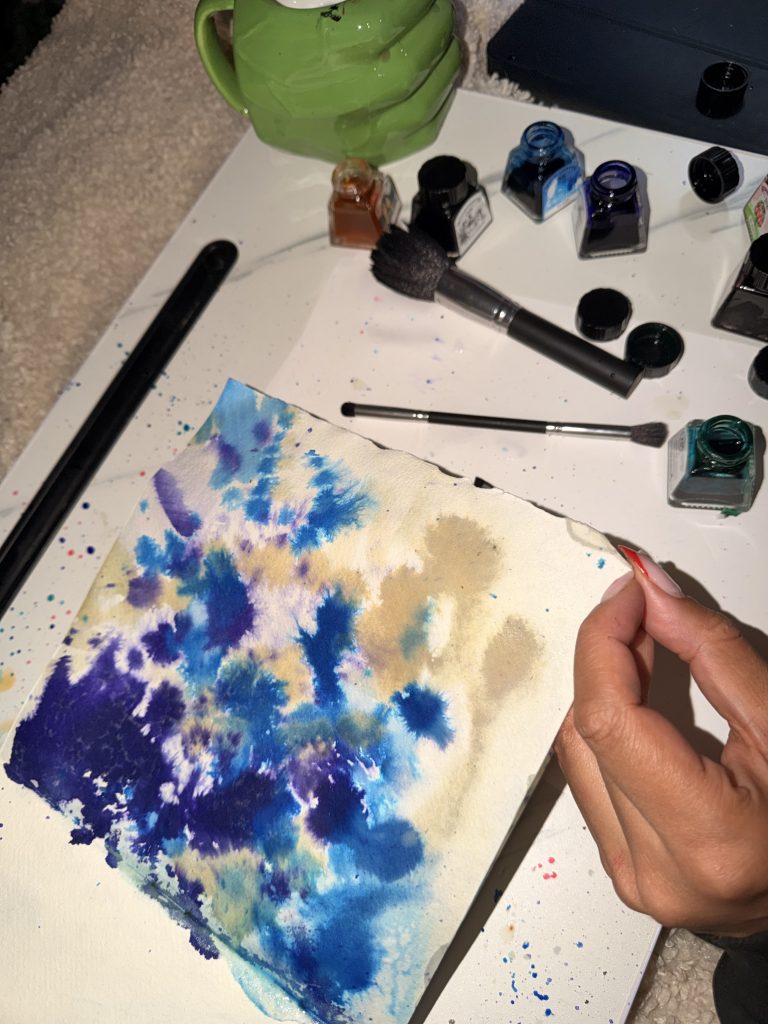

I let the inks arrive randomly, spread, enter the space wherever they chose. Creating movement, expansion, release, vibration.I started on the blue realms — my proportions completely off. I even tried pencil first. Then I realised my practice isn’t about precision. It’s about movement. When I try to manage the movement, the resistance is too much.

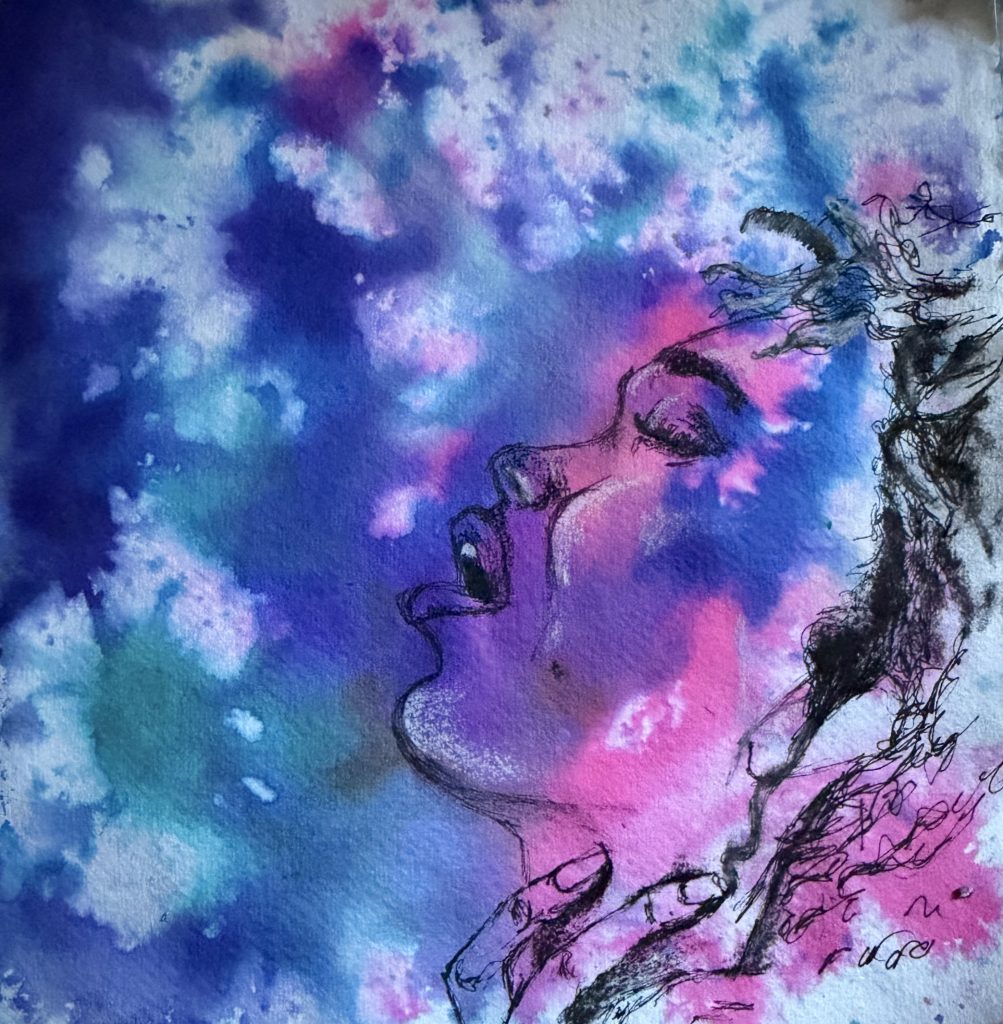
I tested charcoal pencils over the ink. The highlights worked beautifully — enough to show the characteristics of the face without overpowering the background. But the darker charcoal felt too harsh against the ink. So next I’ll play with water-washing the charcoal into the portrait. Diluted charcoal allowing the ink to seep through it.
There is not one without the other. With human experience there’s emotion — so they must coexist together.
No emotions are bad. And they are not meant to possess you — but they cannot be ignored either.
As a neurodivergent person, my nervous system is more sensitive. It’s harder to regulate emotions. We feel deeply anyway. We absorb and notice the energy around us. It’s common that a non-verbal, creative outlet is what actually allows the nervous system to regulate — not talking, not logic. Moving it through the body instead.
Most tools designed to help neurodivergent people regulate emotions are built on neurotypical frameworks. They assume regulation means cognitive control, thinking your way through it. Research increasingly shows those approaches have limited effectiveness for us — and can even cause harm by encouraging masking.
My body already knew this. My mind is only just catching up.
So here I am. Green beside me. Lo-Fi playing. Inks bleeding wherever they choose. She-Hulk quiet for now — not because I suppressed her, but because I gave her somewhere to go.
This is how I move it through.
Leave a Reply